
What are mouth ulcers?
Mouth ulcers (aphthous ulcers, also known as canker sores) are small, round or oval sores in the lining of the mouth. They have a whitish-yellow coating and a red border and usually appear on the inside of the cheeks, the inside of the lips, at the gum line or on the tongue. They burn especially when eating acidic or spicy food and when brushing your teeth.
Mouth ulcers are not contagious. The most common form — small ulcers less than one centimetre across — heals within about one to two weeks without scarring. Larger ulcers can persist for several weeks and should be examined.
Causes: why do mouth ulcers develop?
Why mouth ulcers form is not fully understood. However, there are known factors that can favour or trigger them:
- Minor injuries to the lining of the mouth — biting your cheek, a hard toothbrush, a sharp tooth or filling edge, braces or an aligner
- Stress and lack of sleep
- Hormonal fluctuations, for example in connection with the menstrual cycle
- In some people, certain foods, for example very acidic or spicy dishes or nuts
- A deficiency in iron, vitamin B12, folic acid or zinc
- Sodium lauryl sulphate (SLS), a foaming agent in many toothpastes, is discussed as a possible trigger
Frequently recurring mouth ulcers tend to run in families. In rare cases they are linked to general medical conditions, such as chronic inflammatory bowel disease or coeliac disease. That is why very frequent or unusually severe ulcers are worth having checked by a doctor.
Mouth ulcers on the tongue
On the edge and underside of the tongue, ulcers are particularly unpleasant because the tongue is constantly moving when you speak and chew and rubs against the teeth. Otherwise they are no different from ulcers elsewhere.
If a sore keeps appearing in the same place on the edge of the tongue, there may be a mechanical cause — such as a sharp edge on a tooth or filling. A sore on the tongue that has not healed after two to three weeks should be examined.
Ulcer, herpes or primary herpetic infection?
Not every sore or blister in the mouth is an ulcer. The distinction matters because herpes is contagious and is treated differently.
Ulcer or herpes?
One to a few flat sores with a whitish coating, usually on the mobile lining such as the cheek, inner lip or tongue. No blisters beforehand. Not contagious.
Often starts with tingling, then groups of small blisters form that burst and crust over — usually on the lips, inside the mouth more often on the palate and gums. Contagious.
A primary herpetic infection (herpetic gingivostomatitis) is the first infection with the herpes virus and mainly affects young children: many painful blisters and sores throughout the mouth, swollen gums that bleed easily, often fever and refusal to drink. This should be seen by a paediatrician.
Pressure sores are caused by friction — for example from braces, an aligner or a sharp edge — and disappear once the cause has been removed.
What helps with mouth ulcers?
Mouth ulcers heal on their own. The aim is to relieve the pain and not to irritate the sore further:
- Avoid irritating foods — very acidic, spicy or salty food and hard crusts
- Use a soft toothbrush and be gentle around the sore when brushing
- If ulcers occur frequently, try a toothpaste without sodium lauryl sulphate
- Pain-relieving or protective gels from the pharmacy — ask for advice there
- An antiseptic mouthwash can help keep the sore clean
Rinsing with sage or chamomile tea is often recommended as a home remedy. Its effect is not well documented, but it is generally harmless. Avoid harsh or caustic remedies — they irritate the sore further.
What we can do at the practice
A single ulcer does not require a visit to the dentist. A visit makes sense in these situations:
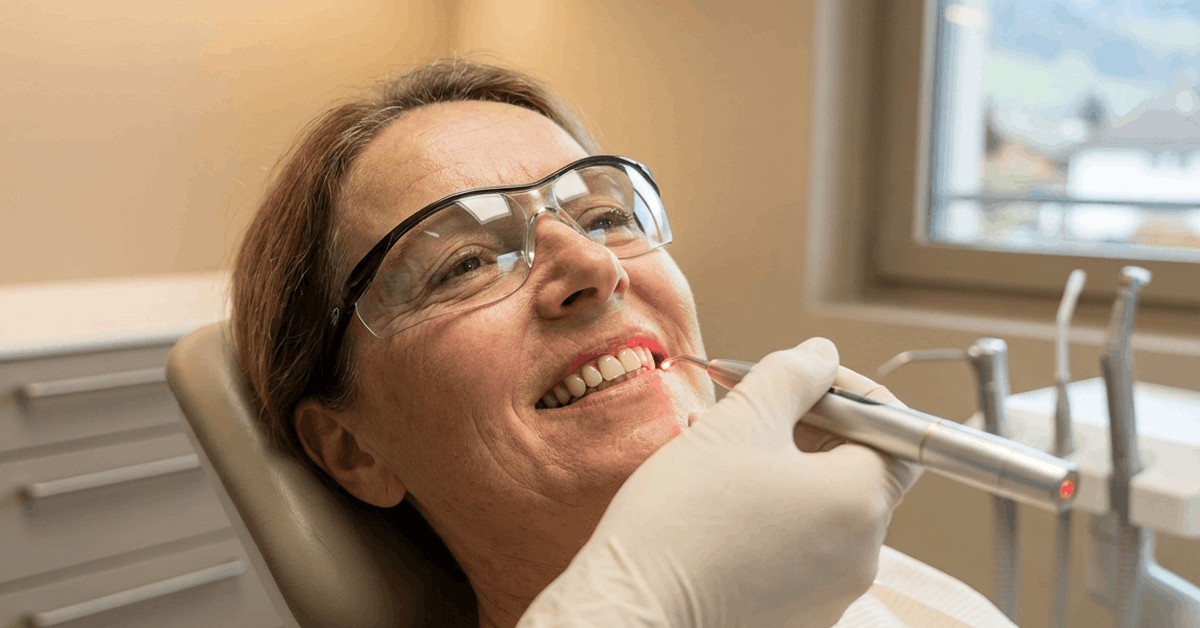
- Pain relief with the laserWith low-level laser therapy we relieve pain from small inflammations in the mouth such as ulcers or herpes — without an injection, from CHF 90 per session.
- Finding the cause in the mouthIf ulcers keep coming back in the same place, we check during a check-up whether a sharp edge on a tooth or filling is injuring the lining of the mouth. If you wear aligners and a tray or attachment is rubbing, get in touch — we will take a look at the spot.
- Assessment of unusual findingsWe examine any sore in the mouth that has not healed after two to three weeks and refer you on specifically if needed.
When to see a doctor or dentist
- The sore has not healed after two to three weeks
- It is larger than about one centimetre or very deep
- Ulcers come back very often or appear in large numbers
- They are accompanied by fever, a general feeling of illness, diarrhoea or problems with the eyes, skin or genital mucosa
- Ulcers appear for the first time and frequently in adulthood, with no recognisable trigger
For investigating general medical conditions — blood values, bowel, skin — your GP is the right point of contact. For anything related to teeth, fillings, braces or aligners, we are here for you.
Do you have a painful spot in your mouth that will not heal, or would you like to try laser therapy? Book an appointment at our practice at Löwenplatz in Zurich — online or on +41 44 363 90 90. You can read how it works in our article Dentist appointment in Zurich.
This article is for general information only and does not replace individual dental advice. Whether and which treatment is right for you is something we determine in a personal consultation based on your individual situation.